


Understanding how to properly claim a mileage write off for taxes can save self-employed professionals, rideshare drivers, and business owners thousands of dollars annually. With the IRS standard mileage rate for 2026 continuing to provide significant deductions, tracking your business miles has never been more important. Whether you drive for Uber, run a delivery service, or travel to client meetings, knowing the rules and maintaining proper documentation ensures you maximize your tax benefits while staying compliant with IRS requirements.
What Is a Mileage Write Off for Taxes
A mileage write off for taxes represents the tax deduction you can claim for business use of your personal vehicle. The Internal Revenue Service allows taxpayers to deduct either the actual expenses of operating a vehicle for business purposes or use a simplified standard mileage rate that combines all vehicle-related costs into one per-mile figure.
For the 2026 tax year, understanding which method works best for your situation requires analyzing your driving patterns, vehicle expenses, and recordkeeping capabilities. The standard mileage rate method offers simplicity, requiring only accurate tracking of business miles driven, the date of each trip, the business purpose, and the destination.
Two Methods for Claiming Vehicle Deductions
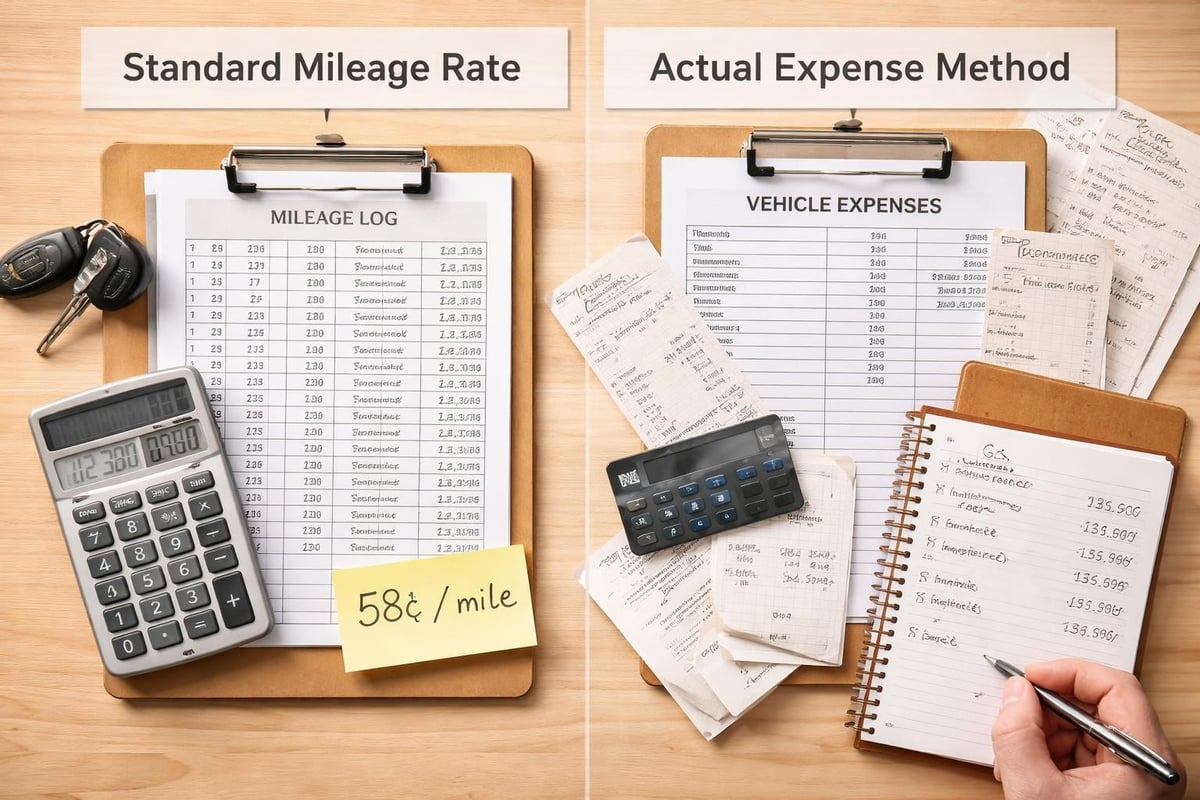
The IRS provides taxpayers with two distinct approaches to calculate their vehicle expense deductions:
- Standard Mileage Rate: Multiply your business miles by the IRS-approved rate
- Actual Expense Method: Track and deduct real costs like gas, insurance, repairs, and depreciation
- Hybrid Approach: Some restrictions apply when switching between methods
Most freelancers and self-employed individuals find the standard mileage rate more convenient because it eliminates the need to track every fuel receipt, maintenance invoice, and insurance payment throughout the year.
Who Qualifies for Mileage Write Offs
Eligibility for mileage deductions extends to several specific groups of taxpayers, each with unique rules and applicable rates. Understanding whether you qualify determines how you approach tracking and claiming these valuable deductions.
Self-Employed Individuals and Business Owners
Self-employed professionals represent the largest group claiming mileage deductions. If you operate as a sole proprietor, independent contractor, or partner in a partnership, you can deduct business mileage on Schedule C of your Form 1040.
This category includes rideshare drivers, delivery couriers, real estate agents, consultants, and anyone who uses their personal vehicle for income-generating activities. The key requirement is that the mileage must be ordinary and necessary for your trade or business.
Employees with Unreimbursed Expenses
Tax law changes in recent years have significantly restricted employees’ ability to deduct unreimbursed business expenses. For most W-2 employees, these deductions were suspended through 2025. However, certain categories of employees may still qualify, including armed forces reservists, qualified performing artists, and fee-basis state or local government officials.
Charitable and Medical Mileage
Beyond business use, the IRS permits deductions for:
- Driving for qualified charitable organizations (different rate applies)
- Medical or moving purposes for active-duty military (specific rate)
- Travel related to medical care (when meeting certain criteria)
| Mileage Type | 2026 Standard Rate | Who Qualifies |
|---|---|---|
| Business | Check current IRS rate | Self-employed, eligible employees |
| Charitable | 14 cents per mile | Volunteers for 501(c)(3) organizations |
| Medical/Military | Check current IRS rate | Active-duty military, qualifying medical travel |
Understanding What Qualifies as Business Mileage
Determining what constitutes business mileage is crucial for accurate deduction claims. The IRS draws clear distinctions between deductible business travel and non-deductible personal or commuting miles.
Deductible Business Miles
Business mileage includes trips that are ordinary and necessary for conducting your trade or business:
- Traveling from your office to meet clients or customers
- Driving between multiple work locations on the same day
- Visiting vendors, suppliers, or business partners
- Attending conferences, trade shows, or professional development events
- Making deliveries or pickups related to your business
- Running business-related errands like banking or purchasing supplies
When you maintain a qualifying home office, the rules become more favorable. Travel from your home office to other business locations typically counts as deductible business mileage rather than commuting.
Non-Deductible Commuting Miles
Your regular commute between home and your primary workplace never qualifies as business mileage, regardless of distance. This remains true even if you work long hours or make business calls during the drive.
However, exceptions exist. If you travel from home to a temporary work location, those miles may be deductible. Similarly, driving from your regular workplace to a second job location counts as business travel.

IRS Documentation Requirements for Mileage Deductions
Proving your mileage to the IRS requires maintaining detailed, contemporaneous records. The tax agency’s substantiation requirements are specific and non-negotiable, making proper documentation essential for defending your deductions during an audit.
The Five Essential Elements
Every mileage log must include five critical pieces of information:
- Date of the trip: The specific day you drove
- Starting point and destination: Where you drove from and to
- Business purpose: Why the trip was necessary for business
- Miles driven: Total distance for the business portion
- Odometer readings: Beginning and ending readings (recommended)
Missing any of these elements can jeopardize your entire deduction. The IRS expects records to be created at or near the time of the expense, not reconstructed months later when preparing your tax return.
Acceptable Tracking Methods
The IRS doesn’t mandate a specific tracking method, but your chosen system must reliably capture the required information:
- Paper mileage logs: Traditional but time-consuming
- Spreadsheets: Digital organization with manual entry
- GPS-based tracking apps: Automated, accurate, and audit-ready
- Combination approaches: Supplementing automated tracking with manual notes
Modern GPS-based applications offer significant advantages over manual methods. They automatically record starting and ending locations, calculate distances, timestamp each trip, and generate IRS-compliant reports. For professionals who make dozens of trips monthly, automation saves hours while reducing errors.
How Long to Keep Records
Maintain your mileage logs and supporting documentation for at least three years from the date you file your tax return. If you underreport income by more than 25%, the IRS can audit returns up to six years old. Many tax professionals recommend keeping records for seven years to be safe.
Calculating Your Mileage Write Off for Taxes
Once you’ve tracked your business miles and chosen your deduction method, calculating your actual tax benefit involves straightforward multiplication and form completion.
Using the Standard Mileage Rate
The calculation couldn’t be simpler: multiply your total business miles by the applicable IRS standard mileage rate. For example, if you drove 10,000 business miles in 2026 and the standard rate is 67 cents per mile, your deduction equals $6,700.
This single calculation replaces tracking individual expenses like:
- Gasoline and oil
- Repairs and maintenance
- Tires and other parts
- Vehicle registration fees
- Insurance premiums
- Depreciation
You can still deduct parking fees and tolls paid during business trips separately, even when using the standard mileage rate.
Actual Expense Method Calculations
The actual expense method requires calculating the percentage of business use, then applying that percentage to your total vehicle expenses. If your vehicle was driven 15,000 miles total, with 10,000 being business miles, your business use percentage is 66.67%.
| Expense Category | Annual Cost | Business Portion (66.67%) |
|---|---|---|
| Gasoline | $3,000 | $2,000 |
| Insurance | $1,200 | $800 |
| Repairs | $800 | $533 |
| Registration | $150 | $100 |
| Depreciation | $4,000 | $2,667 |
| Total | $9,150 | $6,100 |
In this example, the standard mileage rate produces a higher deduction ($6,700 versus $6,100), making it the better choice. However, for expensive vehicles or those with lower fuel efficiency, actual expenses sometimes yield larger deductions.
How to Report Mileage on Your Tax Return
Reporting your mileage deduction varies depending on your employment status and the type of mileage you’re claiming. Self-employed individuals follow different procedures than employees claiming qualified deductions.
Self-Employed Filers Using Schedule C
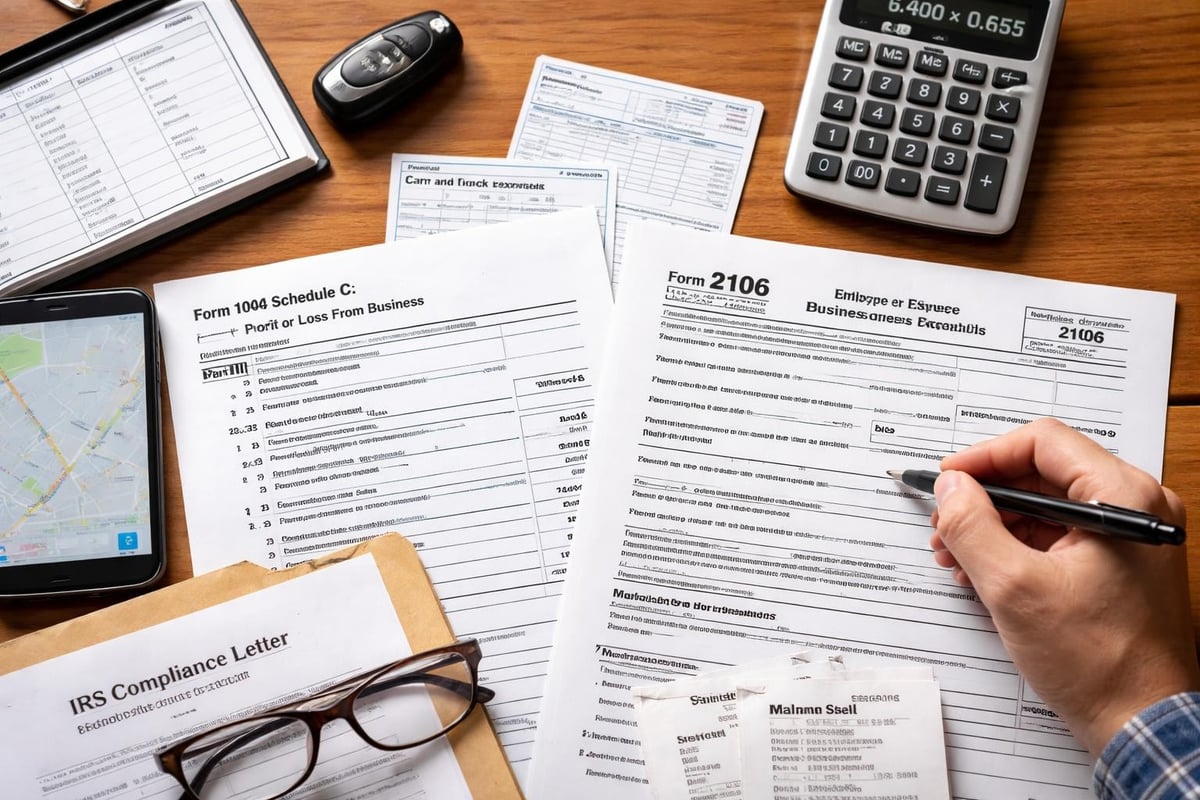
Sole proprietors and single-member LLCs report vehicle expenses on Schedule C (Form 1040), specifically in Part IV. You’ll indicate whether you’re using the standard mileage rate or actual expenses, provide your vehicle information, and answer questions about your usage.
The form requires:
- Date you placed the vehicle in service for business
- Total miles driven during the year
- Business miles driven
- Commuting miles (not deductible)
- Other personal miles
Your business use percentage must be clearly documented. Understanding IRS Revenue Ruling 83-58 provides additional context on compliance requirements for mileage deductions and reimbursement plans.
Employees Filing Form 2106
The limited group of employees who still qualify for unreimbursed business expense deductions must use Form 2106. This form calculates vehicle expenses and carries the result to Schedule 1 of Form 1040.
Maximizing Your Mileage Tax Benefits
Strategic planning and consistent tracking habits can significantly increase your legitimate mileage deductions while maintaining full IRS compliance.
Track Every Eligible Mile
Many self-employed professionals underestimate their business driving. Small trips add up quickly:
- Running to the office supply store: 4 miles
- Meeting a client for coffee: 12 miles
- Picking up materials from a vendor: 8 miles
- Driving to a networking event: 15 miles
These four trips alone represent 39 business miles. At 67 cents per mile, that’s $26.13 in deductions from just one day. Over a year, untracked short trips could cost you hundreds or thousands in lost deductions.
Optimize Your Vehicle Choice
When using the standard mileage rate, the type of vehicle you drive doesn’t affect your per-mile deduction. A hybrid car and a full-size truck both generate the same tax benefit per business mile. However, if you’re considering the actual expense method, vehicle choice significantly impacts your deduction.
Vehicles with higher purchase prices generate larger depreciation deductions. Those with poor fuel economy create higher gas expenses. Understanding these dynamics helps you make informed decisions about which method to use.
Maintain a Home Office
Establishing a qualified home office under IRS rules can convert previously non-deductible commuting miles into deductible business miles. When your home office serves as your principal place of business, trips from home to client locations or other business destinations become fully deductible.
The home office deduction itself provides additional tax benefits, though it comes with specific requirements regarding exclusive and regular business use of a defined space.
Common Mistakes to Avoid
Even experienced business owners make errors when claiming mileage deductions. Understanding these pitfalls helps you maintain compliance and maximize your benefits.
Reconstructing Logs After the Fact
Creating a mileage log months after the trips occurred violates IRS contemporaneous recordkeeping requirements. Estimates and reconstruction rarely withstand audit scrutiny. The solution is simple: track mileage consistently throughout the year, not during tax preparation season.
Mixing Personal and Business Trips
Inflating business mileage by including personal errands represents tax fraud. The IRS specifically prohibits deducting:
- Trips to the gym or personal appointments
- Grocery shopping and household errands
- Commuting from home to your regular workplace
- Vacation travel unrelated to business activities
Forgetting to Track Odometer Readings
While not strictly required for every trip, recording your odometer reading at the start and end of each year provides verification for your total annual mileage. This simple practice strengthens your documentation and helps identify any tracking gaps.
Switching Methods Improperly
The IRS imposes strict rules on switching between the standard mileage rate and actual expense method. If you use actual expenses in the first year, you generally cannot switch to standard mileage for that vehicle. However, starting with standard mileage keeps both options open for future years, though depreciation calculations become more complex.
Technology Solutions for Mileage Tracking
Modern mileage tracking methods leverage GPS technology and smartphone apps to automate the process, dramatically reducing the time burden while improving accuracy.
Benefits of Automated Tracking
GPS-based mileage tracking applications offer compelling advantages:
- Automatic trip detection: Drives are logged without manual intervention
- Precise distance calculation: GPS accuracy eliminates estimation errors
- Complete trip details: Dates, times, routes, and distances captured automatically
- IRS-compliant reporting: Generate audit-ready reports in seconds
- Classification flexibility: Mark trips as business, personal, or commute
- Cloud backup: Never lose your records to a lost phone or crashed computer
For busy professionals managing dozens of trips weekly, automation prevents the documentation gaps that cost money during tax season. The best mileage tracking apps for self-employed professionals combine accuracy, ease of use, and affordability.
Features to Look for in Tracking Apps
Not all mileage tracking solutions offer the same capabilities. When evaluating options, prioritize:
- Automatic trip detection with minimal battery drain
- Easy classification of business versus personal trips
- Customizable trip purposes and client labels
- Multiple vehicle support for users with fleets
- Export capabilities for various tax software platforms
- Secure data storage and privacy protection
- Reasonable pricing without expensive subscriptions
Premium-priced apps often include features that most users never need. Finding a solution that balances essential functionality with affordable pricing makes consistent tracking sustainable long-term.
Planning for 2026 and Beyond
Tax laws and IRS standard mileage rates change periodically, requiring self-employed professionals to stay informed about current regulations and optimize their strategies accordingly.
Annual Rate Adjustments
The IRS typically announces the following year’s standard mileage rates each December. These rates fluctuate based on factors like fuel prices, vehicle depreciation, and operating costs. For 2026, staying current with the official rates ensures accurate deduction calculations.
While the business mileage rate receives the most attention, remember that charitable mileage (set by statute at 14 cents per mile) rarely changes, and medical/military rates follow their own adjustment schedule.
Recordkeeping Best Practices
Establishing solid mileage tracking habits now prevents scrambling at tax time:
- Review and classify trips weekly rather than monthly
- Add detailed business purposes immediately while fresh in memory
- Reconcile your logs against your actual business activities
- Back up your data regularly to multiple locations
- Keep supporting documentation like meeting confirmations and client emails
Consistency matters more than perfection. Even tracking 95% of your business miles produces far better tax results than abandoning the effort entirely after a few missed trips.
Working with Tax Professionals
While mileage tracking itself is straightforward, integrating these deductions into your overall tax strategy benefits from professional guidance. Tax advisors can help you:
- Determine whether standard mileage or actual expenses works better for your situation
- Identify business miles you might be overlooking
- Coordinate mileage deductions with other business expenses
- Plan vehicle purchases for optimal tax treatment
- Respond to IRS inquiries or audits regarding vehicle expenses
The money saved through proper mileage deduction planning typically far exceeds the cost of professional tax preparation.
Claiming a mileage write off for taxes requires understanding IRS rules, maintaining detailed records, and choosing the calculation method that maximizes your legitimate deductions. The combination of consistent tracking habits and modern GPS technology makes compliance easier than ever while ensuring you capture every dollar you’re entitled to deduct. Whether you’re a rideshare driver, delivery contractor, or consultant, Milelify offers the automated tracking and reporting capabilities you need to maximize your tax savings without the complexity of expensive subscription services.