


If you drive for work and you’re not using an HMRC mileage claim calculator, you’re almost certainly leaving money on the table. Mileage Allowance Relief is one of the most consistently underclaimed tax reliefs available to UK workers, freelancers, and self-employed drivers. The rules are straightforward, the approved rates are clearly published, and the calculation is simple arithmetic. Yet thousands of eligible drivers either don’t claim at all or claim less than they’re entitled to simply because they don’t have a reliable system for tracking and calculating their business miles.
This guide covers everything you need to know about the HMRC mileage claim calculator process in 2026: what the approved rates are, how the calculation works for every vehicle type, who can claim, what records HMRC expects you to keep, and how a dedicated mileage tracking tool makes the entire process faster, more accurate, and fully compliant.
Whether you’re self-employed, a freelancer, a gig worker, or an employee using your own car for business travel, understanding how to use an HMRC mileage claim calculator correctly is one of the most straightforward ways to reduce your tax bill this year.
What Is the HMRC Mileage Claim Calculator and How Does It Work?
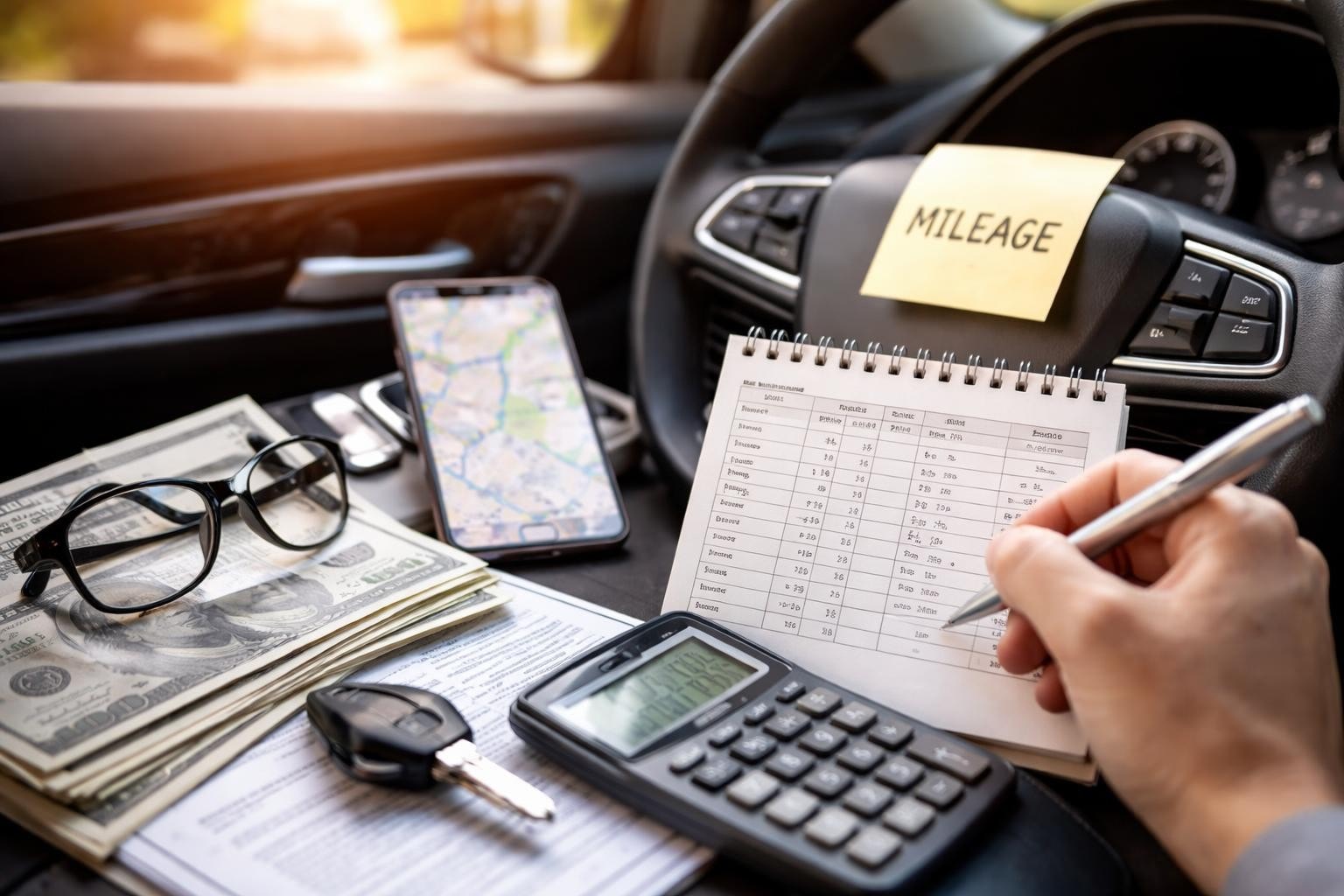
An HMRC mileage claim calculator is any tool, whether a manual formula, a spreadsheet, or a dedicated mileage app, that uses HMRC’s approved rates to calculate the tax relief or reimbursement you can claim for using your own vehicle on business journeys. The underlying calculation is simple: multiply your total business miles by the approved rate for your vehicle type, and the result is the amount you can claim tax-free.
The HMRC Approved Mileage Rates for 2025/26
HMRC sets Approved Mileage Allowance Payments (AMAPs) each tax year. For 2025/26, the rates remain consistent with the previous year, which is now the fourteenth consecutive year they have stayed at the same level despite rising vehicle running costs. Here is the complete rate table:
| Vehicle Type | First 10,000 Miles | Over 10,000 Miles |
|---|---|---|
| Cars and Vans | 45p per mile | 25p per mile |
| Motorcycles | 24p per mile | 24p per mile |
| Bicycles | 20p per mile | 20p per mile |
| Electric Vehicles | 45p per mile | 25p per mile |
One additional rate applies in specific circumstances: if you carry a fellow employee as a passenger in your own car or van during a business journey, you can claim an extra 5p per mile per passenger on top of your standard rate. This passenger payment is tax-free up to that amount.
These rates are designed to cover the full cost of business travel in your own vehicle, including fuel, insurance, servicing, depreciation, and road tax. You do not need to keep separate receipts for these expenses if you’re claiming the approved mileage rate. The flat rate covers everything.
How to Calculate Your HMRC Mileage Claim: Step by Step
The calculation is straightforward once you have your business mileage total for the tax year. Here’s how to apply the HMRC mileage claim calculator formula:
- Total your business miles driven during the tax year, separating by vehicle type if you use more than one
- Apply the tiered rate for cars and vans: multiply the first 10,000 miles by 45p, then multiply any miles above 10,000 by 25p
- Add the two figures together for your total claimable amount
- Add passenger payments if applicable (5p per mile per passenger carried on business trips)
For example: if you drove 14,000 business miles in your car during the 2025/26 tax year, your calculation would be:
- First 10,000 miles: 10,000 × £0.45 = £4,500
- Remaining 4,000 miles: 4,000 × £0.25 = £1,000
- Total claimable: £5,500
That £5,500 reduces your taxable income directly, meaning the actual tax saving depends on your tax rate. A basic-rate taxpayer saving at 20% would recover £1,100. A higher-rate taxpayer saving at 40% would recover £2,200. These are meaningful sums that are fully legal, fully HMRC-approved, and entirely dependent on accurate mileage records.
What Counts as a Qualifying Business Journey
Not every mile you drive qualifies for the HMRC mileage claim. The rules have specific boundaries that are important to understand before you calculate your claim:
- Qualifying journeys: client visits, travel between different workplaces, trips to suppliers, business meetings, work-related training at temporary locations
- Non-qualifying journeys: your regular commute from home to a permanent workplace, personal errands, social travel, and any journey that is primarily private even if a work task is incidentally completed
The commuting exclusion catches many claimants off guard. Driving from your home to the same office every day does not qualify, regardless of how far that commute is. However, if you work from home as your primary business base, then travel from home to client sites or temporary workplaces qualifies in full. This is a commonly misunderstood distinction that a qualified tax adviser can help clarify for your specific circumstances.
Who Can Claim Using an HMRC Mileage Claim Calculator?
The HMRC mileage claim calculator is relevant to a wider range of workers than most people realise. The rules apply differently depending on your employment status, but the core principle is the same: if you use your own vehicle for qualifying business travel and you’re not receiving the full approved mileage rate from an employer, you’re entitled to tax relief on the difference.
Self-Employed Individuals and Sole Traders
If you’re self-employed, mileage is one of the most valuable allowable expenses you can claim on your Self Assessment tax return. Rather than tracking every individual vehicle cost, which includes fuel, insurance, maintenance, and depreciation separately, the flat-rate HMRC mileage claim method simplifies everything into a single number per mile.
For the 2025/26 tax year, you can claim 45p per mile for the first 10,000 business miles in a car or van, and 25p per mile thereafter. This is entered in the “Car, van and travel expenses” section of your Self Assessment return under self-employment income and expenses. The total reduces your taxable profit directly, lowering your Income Tax and Class 4 National Insurance bill.
One important rule for self-employed drivers: once you begin claiming mileage using the flat-rate method in the first year of ownership of a vehicle, you must continue using that method for the same vehicle. You cannot switch between flat-rate and actual costs mid-ownership. This makes the initial choice significant, and most self-employed drivers with typical business mileage find the flat-rate method more generous and far simpler to administer.
Employees Using Personal Vehicles for Work
Employees who use their own car, van, or motorcycle for business travel and receive less than the approved HMRC mileage rate from their employer can claim the difference as Mileage Allowance Relief (MAR). This is done either through Form P87 (for employees not filing a Self Assessment return) or through Self Assessment if you already file one.
If your employer pays you nothing for business miles, you can claim the full approved rate. If they pay 30p per mile for a car journey and the approved rate is 45p, you can claim relief on the 15p per mile difference. According to HMRC’s own guidance, this relief is applied at your marginal tax rate, meaning a basic-rate taxpayer gets 20% of the difference back, and a higher-rate taxpayer gets 40%.
Freelancers, Gig Workers, and Delivery Drivers
The gig economy has made mileage claims more relevant than ever for a growing segment of the UK workforce. Delivery drivers, rideshare drivers, freelance tradespeople, and contract workers who travel between client locations all accumulate qualifying business mileage that is fully claimable. Research consistently shows that gig and freelance workers are among the most likely to underclaim expenses, in many cases simply because they lack a reliable system for tracking their miles throughout the year.
For these workers in particular, the difference between claiming accurately and not claiming at all can be hundreds or thousands of pounds per tax year. A driver covering 15,000 business miles annually in a car would be entitled to claim £5,000 in mileage allowance, producing a tax saving of £1,000 at basic rate. That money doesn’t require any additional income. It requires only an accurate mileage log.
How to Keep HMRC-Compliant Mileage Records
Using an HMRC mileage claim calculator is only half the process. HMRC requires you to keep supporting records that prove every business mile you claim was a genuine qualifying journey. Without a proper mileage log, your claim is vulnerable in the event of a tax inspection, and HMRC can and does challenge undocumented mileage claims.
What Your Mileage Log Must Include
HMRC does not prescribe a specific format for mileage logs, but the information required is clear. For each business journey, your record should include:
- The date of the trip
- The start location and destination
- The purpose of the journey (for example, “client meeting at [company name]” or “delivery to [location]”)
- The total business miles driven
You do not need to record personal journeys separately unless you want to provide a complete picture of your total driving. HMRC’s interest is in the business miles, not the personal ones.
These records must be kept for at least five years after the relevant tax year’s submission deadline. HMRC can open an enquiry into returns from previous years, and a mileage claim without supporting documentation is one of the most common triggers for adjustments during tax inspections.
Why Manual Mileage Logs Fall Short
Paper mileage logs and spreadsheet-based tracking are technically HMRC-compliant if completed accurately. In practice, they rarely are. Research from mileage tracking providers consistently finds that drivers using manual systems underestimate their business mileage by an average of 20-25% compared to GPS-tracked records, simply because they forget to log short trips, misremember distances, or stop maintaining the log during busy periods.
The cumulative effect of that underestimation is significant. A driver consistently undercounting by 20% on 10,000 annual business miles is missing out on tax relief on 2,000 miles, which at 45p per mile and a basic rate of 20% represents £180 left unclaimed every year. Over a five-year period that’s £900, far more than the cost of any mileage tracking subscription.
The more serious risk is the opposite direction: if you claim miles you didn’t drive or cannot evidence, HMRC can disallow the claim, charge penalties, and add interest. Accurate records protect you both ways.
Using a Mileage Tracking App for HMRC Compliance
The most reliable solution to HMRC-compliant mileage record-keeping in 2026 is a dedicated GPS mileage tracking app. These tools automatically record route data as you drive, calculate exact distances including real road routes rather than straight-line estimates, and store the records in a format that satisfies HMRC’s evidential requirements.
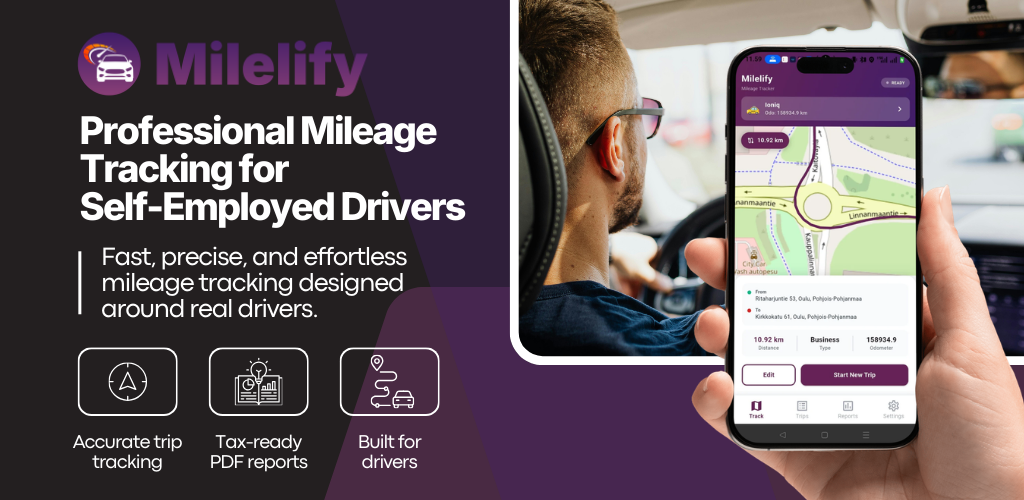
Milelify is a fast, accurate mileage tracker built specifically for self-employed drivers, freelancers, and businesses operating in the UK and internationally. It tracks every kilometre and mile with high-precision GPS, categorises trips as business or personal, and generates HMRC-compliant mileage reports that you can export as PDF or CSV for your accountant or Self Assessment submission.
Key features that make Milelify the right tool for UK drivers claiming mileage:
- One-tap start and stop tracking with full control over when recording begins and ends, no unnecessary background surveillance
- Automatic HMRC mileage rate calculation using the current approved rates, so your reimbursement or tax relief figure is calculated instantly alongside your mileage log
- HMRC-compliant report export in PDF and CSV formats ready to submit or hand to your accountant
- Business and personal trip separation so your mileage log is clean and tax-ready from day one
- Secure cloud storage accessible from your phone and a web dashboard, with full data encryption
HMRC Mileage Claim Calculator: Common Mistakes and How to Avoid Them
Even with a clear understanding of the HMRC approved rates, many drivers reduce their claim or create compliance risk through avoidable errors. These are the most common mistakes and how to correct them.
Mistake 1: Claiming Commuting Miles
The most widespread error is including regular home-to-office commuting miles in a business mileage claim. HMRC is explicit on this point: travel between your home and a permanent workplace does not qualify for Mileage Allowance Relief. This applies even if the commute is long, inconvenient, or incurs significant costs.
The exception, as noted earlier, applies to genuinely self-employed workers who use their home as their principal place of business. For these individuals, travel from home to a client’s premises or a temporary work location qualifies in full. If you’re unsure whether your home qualifies as your principal place of business under HMRC’s rules, HMRC’s own guidance on expenses and allowances provides the relevant framework, or a qualified accountant can advise.
Mistake 2: Using Estimated or Straight-Line Distances
Many drivers estimate their mileage based on rough recollection rather than actual route distances. This creates two problems: the estimate is often inaccurate, and it is not supported by evidence in the way GPS-tracked data is. HMRC expects your mileage claim to reflect actual distances driven, which means using the real road distance of each journey, not a straight-line figure or a rough approximation.
A GPS mileage tracking app like Milelify eliminates this entirely by recording the actual route driven rather than calculating a theoretical distance, producing mileage figures that are both accurate and defensible in the event of an HMRC enquiry.
Mistake 3: Missing the 10,000-Mile Threshold Correctly
The tiered rate structure for cars and vans catches some drivers out. The 10,000-mile threshold applies to total business miles in a single tax year, regardless of how many different vehicles you use. If you drive two different cars for business during the tax year, their business miles are combined when determining whether you’ve crossed the 10,000-mile threshold.
Some drivers also mistakenly apply the 25p rate from the beginning of the year rather than correctly applying 45p to the first 10,000 miles and 25p only above that. Using a mileage calculator that applies the tiered rate correctly from the outset avoids this error entirely.
Mistake 4: Not Claiming at All Because the Amount Seems Small
Many low-mileage drivers, particularly employees who occasionally use their car for business trips, assume the amount they can claim is too small to be worth pursuing. This is rarely true in practice. Even 1,000 business miles in a car at 45p per mile produces a £450 deduction, which at basic rate delivers £90 back. Across a four-year claim window (HMRC allows backdated claims for up to four tax years), that’s £360 from a simple, documented claim.
The administrative effort of making an HMRC mileage claim is minimal when you’ve kept accurate records throughout the year. The barrier is record-keeping, not the claim process itself, which is why setting up a tracking system at the start of the tax year, rather than trying to reconstruct mileage at submission time, is always the right approach.
Making Your HMRC Mileage Claim: Self Assessment vs Form P87
The process for claiming your calculated mileage allowance differs depending on your employment status, and choosing the right route ensures your claim is processed correctly.
For Self-Employed Individuals: Self Assessment
If you file a Self Assessment tax return, your mileage claim is submitted as part of your annual return under the “Car, van and travel expenses” category within your self-employment income and expenses section. You enter your total allowable mileage amount, which is the figure produced by applying the HMRC approved rates to your total business miles for the year.
Keep your mileage log and any supporting records available but do not submit them with your return. HMRC may request them if they open an enquiry, but they are not required at the point of submission. The claim reduces your taxable profit directly.
For Employees: Form P87 or Self Assessment
Employees who are not required to file a Self Assessment return but want to claim Mileage Allowance Relief can do so using HMRC’s Form P87. This can be submitted online through the Government Gateway or by post. You’ll need your employer’s PAYE reference, the total business miles driven, and the total amount already reimbursed by your employer (if any).
If you are already filing a Self Assessment return for other reasons, add your employee mileage claim there instead of submitting a separate P87. Backdated claims for previous tax years can also be made using this form, covering up to four previous tax years, which means if you’ve been driving for work and not claiming, there may be a meaningful refund available.
The Simplest Way to Stay on Top of Your HMRC Mileage Claims in 2026
The gap between what UK drivers are entitled to claim and what they actually claim in mileage relief is a persistent feature of the tax system. The rules are clear, the rates are published, and the calculation is simple. The only thing standing between most drivers and their full entitlement is an accurate, consistent mileage log maintained throughout the year.
Manual systems fail because they depend on memory and discipline in equal measure. GPS-powered mileage tracking apps succeed because they remove both dependencies entirely. You drive, the app records, the mileage log builds itself, and the HMRC mileage claim calculator does the arithmetic automatically.
Start tracking your business miles with Milelify today and generate your first HMRC-compliant mileage report in minutes, so you never miss a mile, and never leave a claimable pound behind.